
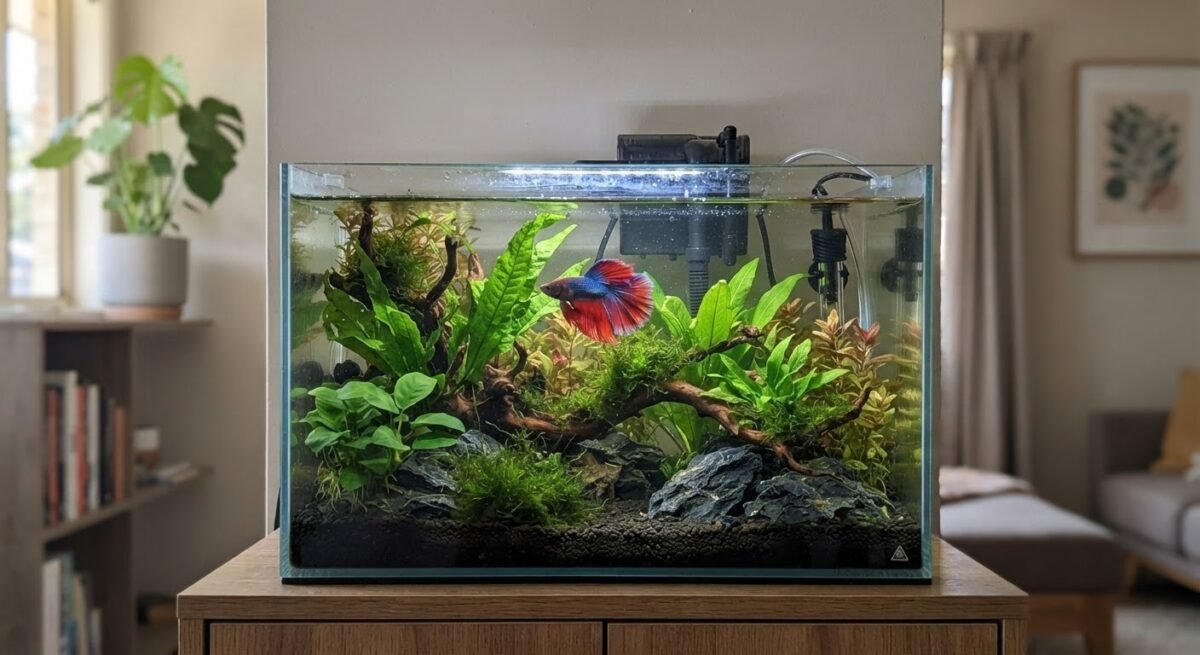
Aim for 20 litres or more for one betta, because RSPCA Australia calls 10 litres the absolute minimum and says bowls are too small. Add a heater set to 24 to 26°C, a gentle filter and a lid. Plan on 40 litres or more if you want tank mates.
How big should a betta fish tank be? RSPCA Australia says 20 litres or more, and treats 10 litres as the absolute minimum. Bowls and vases don’t make the cut. Go bigger if you want tank mates: RSPCA’s tank-mate advice starts at 40 litres. This guide covers one male Siamese fighting fish in a heated, filtered freshwater tank.
Scope: the numbers here are for a single betta (Betta splendens) in a freshwater tropical tank. Keeping several females together, breeding and saltwater are different jobs. Keeping bettas is legal in most places, but rules on ornamental fish can differ by state and change over time, so check your state Fisheries or Biosecurity department before buying.
Setting up a betta tank for the first time? The Betta Fish guides cover the whole path, and the best betta fish tanks roundup compares actual tanks.
How Big Should a Betta Fish Tank Be? The Numbers
RSPCA Australia’s care page for Siamese fighting fish gives the clearest local benchmark. Here’s how it stacks up against what you’ll see on shop shelves.
| Tank volume | What it means for a betta |
|---|---|
| Under 10 litres | Below the RSPCA minimum. Bowls, vases and most novelty tanks sit here. |
| 10 litres | RSPCA calls this the absolute minimum. Water quality swings fast. |
| 20 litres or more | RSPCA’s ideal, so the fish can show normal activity. Roughly a 40 x 25 x 20 cm tank. |
| 40 litres or more | The size RSPCA gives for keeping a betta with peaceful tank mates such as corydoras. |
To check what your own tank holds, multiply length by width by height in centimetres, then divide by 1,000. Our litres guide shows how to allow for the water sitting below the rim.
Why a Bigger Tank Works Better
A betta’s waste turns to ammonia. In 10 litres, a little overfeeding pushes ammonia up quickly. In 20 litres or more, the same mistake gets diluted.
That’s the real reason RSPCA’s ideal is 20 litres, not just the swimming room. More water means steadier temperature and steadier chemistry, so you get more forgiveness on the days you forget.
The old line that bettas ‘live in puddles’ gets repeated on shop labels. It’s not a reason to keep one in a bowl. RSPCA states that small tanks and fish bowls don’t provide adequate space.
What Else the Tank Needs
Size is only the start. A 20 litre tank still fails a betta without these.
- A submersible heater holding 24 to 26°C. RSPCA says room temperature is generally too cold and can fluctuate. Aqua One’s manual says 1 watt heats 1 litre, so a 20 litre tank points to a heater around 25 W.
- A filter with adjustable flow. Bettas prefer low flow, because strong current pushes long fins around. A sponge filter or a baffled outlet works.
- A lid, with a gap under it. RSPCA says to fit a lid to stop escapes, and to leave space between the water and the lid so the fish can reach air.
- Plants or other cover. RSPCA notes bettas prefer several plants, real or artificial, to explore and rest in. See plants that suit a betta tank.
- A cycled tank. Bettas are no exception to the nitrogen cycle. Follow how to cycle a fish tank first, and test until ammonia and nitrite read 0.
An Australian summer can push a lightly heated small tank above the 24 to 26°C range, and a tank in a hot north-facing room warms faster than a big one. Small volumes also swing faster than large ones, so check the thermometer during a heatwave. Our temperature guide covers what to do.
Tank Size With Tank Mates
Bettas can be territorial, and two males must never share a tank. RSPCA says a betta can live with peaceful species such as corydoras, otocinclus catfish or a shoal of five or more neon tetras, but only in a tank of at least 40 litres. Some fishkeeping references, including Seriously Fish, advise keeping a betta alone. Both views agree on one thing: extra fish need extra water. The tank mates guide covers who works and who doesn’t.
Common Mistakes
- Buying a bowl or vase kit. The volume is under RSPCA’s minimum and there’s no room for a heater or filter.
- Skipping the heater because the fish ‘looks fine’. Cold water slows a betta’s appetite and immune system.
- Choosing strong filter flow. Fins tear and the fish hides. Turn the flow down or add a baffle.
- Overfeeding. RSPCA says to feed once a day, only what the fish eats in under two minutes.
- Leaving out the lid. Bettas jump.
When to Call It
Say your betta’s water still reads above 0.1 ppm ammonia or 0.2 ppm nitrite (the RSPCA limits) after the tank has cycled. The tank is likely too small for your feeding routine. Move up in size before treating the fish. If the fish is clamped, gasping or has torn fins that aren’t healing, talk to a vet with fish experience.
Related Guides
Keep reading on the same topic:
Frequently Asked Questions
What is the smallest tank a betta can live in?
RSPCA Australia gives 10 litres as the absolute minimum. It recommends 20 litres or more so the fish can show normal activity.
How big should a betta fish tank be for two fish?
Two males must never share a tank, whatever its size. A betta paired with a different, peaceful species needs at least 40 litres according to RSPCA. Shared betta setups such as female groups are outside this guide and need much more space and planning.
Do bettas need a heater?
Yes. RSPCA says a submersible heater is the only way to hold 24 to 26°C, since room temperature is generally too cold and can fluctuate. In an Australian summer the heater may rarely run, but you still want it for cool nights.
Can a betta live in a bowl without a filter?
No. RSPCA says fish bowls don’t provide adequate space, and it calls for filtration of a suitable size with adjustable flow. Without a filter, ammonia builds in the water and the tank can’t cycle.
What water quality does a betta need?
RSPCA lists ammonia under 0.1 ppm, nitrite under 0.2 ppm, nitrate under 50 ppm and pH between 6.5 and 7.5. Do a 10 to 25 per cent water change every week and test with a liquid kit.
