

Dragon stone and black lava rock are the safest starting points for most tanks, and both cost $10 to $12 per kilo. Seiryu, Texas holey rock and some mountain stone raise hardness and pH, which helps African cichlids and hurts soft-water fish. Test every rock before it goes in, whatever the label says.
The best rocks for aquarium scapes are stones that hold their shape underwater, give you caves, cliffs and terraces to build with, and either leave the water chemistry alone or change it in a way you chose on purpose. Inert rocks are the safe default for planted tanks and soft-water fish. Carbonate rocks are a tool for hard-water fish.
Seven types turn up in Australian shops. Dragon stone, black lava rock, slate and petrified wood are described as inert. Seiryu stone and Texas holey rock are limestone-type rocks that raise hardness and pH. Mountain stone sits in between, with one seller warning that some pieces contain lime.
Two numbers matter. Price runs from about $9.50 to $12 per kilo across the seven types, and the reading that decides whether a rock is safe is your own GH, KH and pH before and after it goes in. Weight per litre is not a figure I could source, so check your tank and stand rating rather than trusting a rule.
This guide covers rock sold in Australia for freshwater tanks. It leaves out driftwood, wild-collected stone and plastic ornaments, and you will find more in the aquarium decoration guides on this site.
Do not collect rocks from national parks or bushland. Removing rock without consent in a NSW national park is reported to carry a fine of up to 100 penalty units under the National Parks and Wildlife Regulation 2019, and other states have similar rules, so check with the park authority. Wild stone can also carry metals, pyrite or limestone, which is a good reason to buy tested aquascaping rock instead.
Best Rocks for Aquarium in Australia, Compared
| Rock | Water Effect | Best For | Key Trait |
|---|---|---|---|
| Dragon Stone (Ohko) | Described as inert, test first | Planted tanks and moss | Honeycomb pits, light, fragile |
| Black Lava Rock | Inert | Budget hardscape, attaching plants | Porous and jagged |
| Seiryu Stone | Raises GH, KH and pH | Dramatic scapes in hard water | Dense limestone with white veins |
| Black Slate | Inert per seller | Terraces, caves and ledges | Flat, stackable slabs |
| Petrified Wood | Inert per seller | Natural colour in small tanks | Wood-grain patterns in stone |
| Mountain Stone | May slightly raise hardness | Canyon and cliff layouts | Sandy, textured surface |
| Texas Holey Rock | Raises pH, GH and KH | African cichlid tanks | Pale limestone full of holes |
How I Compared These Rocks
Prices come from live Australian listings checked on 29 September 2026 (School of Scape, Nano Tanks Australia, Aquaristic Online, Roxy Aquarium and Kellyville Pets). Chemistry claims come from the sellers plus aquariumscience.org, Thomas Acres and Gensou testing guides. Reddit and the planted-tank forums blocked me, so owner complaints rest on forum summaries and retailer reviews, and seller-hosted star ratings are low-independence. productreview.com.au, CHOICE and Canstar Blue do not cover aquarium rock. I found no ACCC recall for aquarium rock in a search.
1. Dragon Stone (Ohko) – Best all-round hardscape rock for planted tanks

Dragon stone is the rock most planted-tank keepers start with. The pitted surface gives moss and anubias something to grip, and it is light enough to stack tall without stressing the glass. School of Scape lists it at $12 per kilo, and its reviewers report no shift in water parameters.
Real owners still find two problems. Clay residue keeps leaching from the crevices even after scrubbing (Bantam Earth and a Planted Tank forum thread), and the rock is fragile enough to snap in shipping. One forum poster also suspects several different rocks get sold under the Ohko name, so run a test soak anyway.
Against black lava rock below, dragon stone looks better and costs about $2 more per kilo. It pairs well with the plants in the best aquarium plants for beginners guide.
Pros
- Pitted surface holds moss and anubias
- Light for its size, easy to stack
- Sellers and testing guides describe it as inert
Cons
- Clay keeps leaching from crevices after scrubbing (Bantam Earth, Planted Tank forum)
- Fragile and can break in shipping
- Some owners suspect mixed rock types sold under the name
2. Black Lava Rock – Best low-cost inert rock for attaching plants

Lava rock is the cheapest inert option here, at $10 per kilo from School of Scape and $10.95 at Roxy Aquarium. Aquariumscience.org lists it as safe, and the rough surface takes plant roots and moss without any fuss.
One warning. That same site calls the claim that lava rock removes nitrate marketing hype, so treat it as a good surface for bacteria and nothing more. Guides split on the jagged edges, with some warning that long-finned bettas and fancy guppies can tear a fin, and others saying rock edges are too dull to cut a fish. I found no real owner complaint, and Roxy’s listing has no reviews yet, which is an honest gap in the evidence.
Pros
- Cheapest inert rock at $10 to $10.95 per kg
- Rough surface grips plants and moss
- Aquariumscience.org lists it as safe
Cons
- Jagged edges may tear the fins of bettas and fancy guppies, though sources disagree
- Nitrate-removal claims are marketing (aquariumscience.org)
- No independent owner reviews found
3. Seiryu Stone – Best for dramatic scapes in hard water

Nothing builds a mountain range like Seiryu. It is dense, angular and veined, and School of Scape ($10 per kilo), Nano Tanks Australia ($10) and Aquaristic Online ($9.50, on preorder) all sell it. Both School of Scape and Nano Tanks say plainly that it can raise hardness and pH.
That makes water supply matter. Sydney tap water measures about 49 mg/L of hardness, which is soft, so Seiryu will shift parameters there over weeks. Adelaide’s CBD supply sits near 97 mg/L, about 5.4 dGH, so the effect is smaller but not zero. One forum poster reported pH rising from about 7 to 8.4 overnight with small pieces, though other keepers run it with shrimp.
The edges are sharp to handle, and sellers warn about long-finned fish, loaches and fancy goldfish. Compared with slate, it looks better and costs the same, but it changes the water.
Pros
- Dramatic veined look for cliffs and caves
- Cheaper than dragon stone at $9.50 to $10 per kg
- Useful for hard-water fish that like buffered water
Cons
- Raises hardness and pH over weeks, a problem in soft water (Thomas Acres, Nano Tanks)
- One forum owner reported pH rising from 7 to 8.4 overnight
- Sharp edges flagged for delicate fish, though sources disagree on the risk
4. Black Slate – Best for flat terraces, ledges and caves
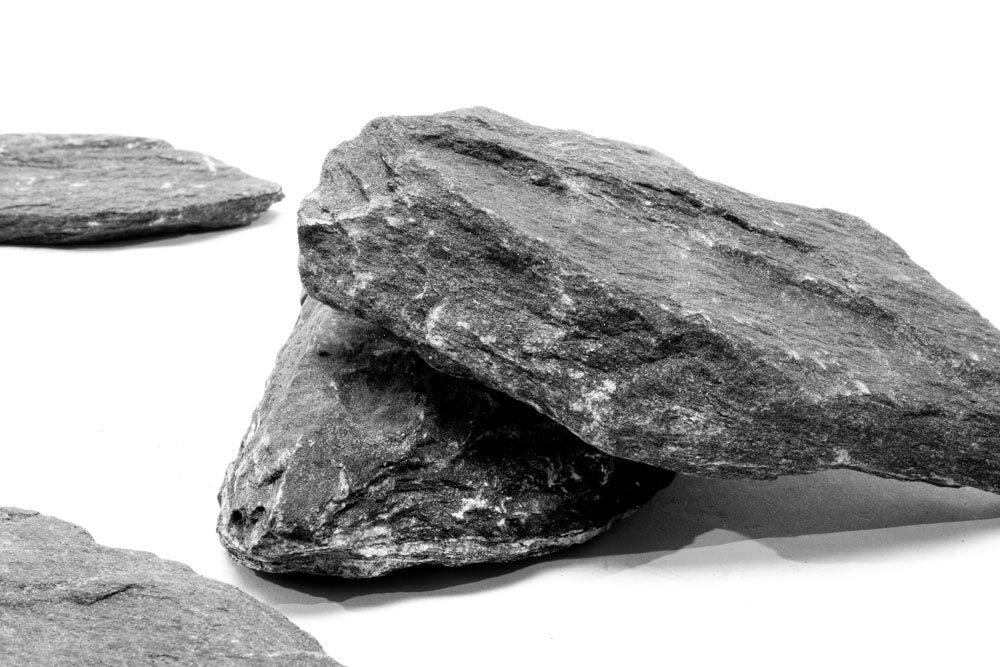
Slate stacks like books. Flat slabs make ledges for shrimp, caves for loaches and terraces for planting, and School of Scape sells it at $10 per kilo with mixed sizes. Reviewers on that listing call it good value with a nice spread of sizes, though there are only two reviews.
It does need securing. The seller says flat pieces can shift unless fixed, and some edges may need smoothing for delicate species. Slate from unknown sources can also contain pyrite, so a test soak is worth the two weeks. If you would rather not wait, black lava rock above needs no such shaping.
Pros
- Flat slabs stack into ledges and caves
- $10 per kg for mixed sizes
- Seller lists it as inert
Cons
- Flat pieces can shift unless secured (seller warning)
- Some edges may need smoothing for delicate species
- Only two reviews on the seller listing
5. Petrified Wood – Best natural colour without driftwood

This is stone, not spiderwood, and it will never rot, soften or stain the water brown. Pieces keep their wood grain in orange, brown and cream, which suits small tanks where a big grey rock would overwhelm the layout.
The evidence is the thinnest in this list. School of Scape lists it as inert and safe for freshwater at $10 per kilo, with 23 reviews, but that rating is seller-hosted and I found no independent complaint or praise. Buy a small bag and test it before committing.
Pros
- Wood grain look with none of the tannins
- Sold at $10 per kg
- Seller lists it as safe for freshwater
Cons
- Evidence rests on seller copy and seller-hosted reviews
- No independent owner reports found
- Pieces are small, so covering a big scape costs more
6. Mountain Stone – Best for sandy canyon and cliff layouts
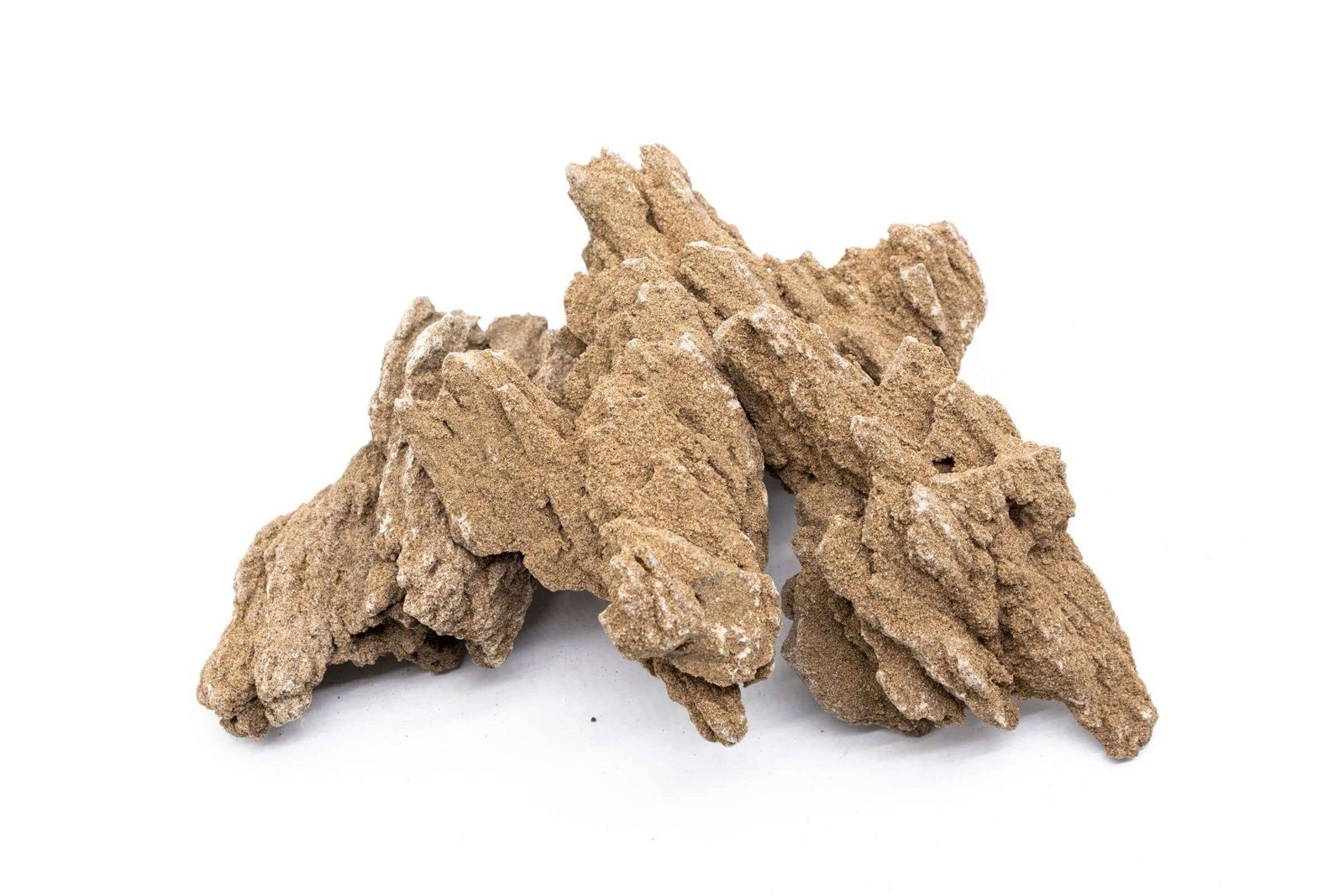
The sandy surface gives a desert canyon look that neither dragon stone nor slate can match. School of Scape lists it at $12 per kilo with 26 reviews and states that some pieces may contain lime, which can slightly raise hardness, so it recommends regular testing.
That is the honest headline. It is not clearly inert, and the only source I found is the seller itself. Use the vinegar drip and the two-week soak below, and expect the same caution as Seiryu on soft tap water.
Pros
- Distinct sandy canyon look
- 26 reviews on the seller listing
- Seller openly discloses the lime warning
Cons
- Some pieces may contain lime and raise hardness (seller warning)
- Most expensive at $12 per kg alongside dragon stone
- No independent owner reports found
7. Texas Holey Rock – Best for African cichlid tanks

Texas holey rock is a specialist pick. It is limestone, it buffers water upwards, and Aquaristic Online lists it at $9.50 per kilo as essential for African cichlids. Aquariumscience.org says calcium carbonate rocks push pH toward 7.6 to 7.9, which suits Malawi and Tanganyika fish and hurts tetras, discus and most soft-water shrimp.
One Australian listing gets the chemistry backwards. Kellyville Pets says calcium carbonate lowers pH, and it does the opposite, so do not trust that line. Owner reviews there and at Aquaristic mention pieces that were less perforated than expected and large pieces that needed breaking.
Pros
- Buffers water upward for African cichlids
- $9.50 per kg at Aquaristic Online
- Holes make natural caves
Cons
- Raises pH and hardness, wrong for soft-water fish (aquariumscience.org)
- Reviewers found pieces less perforated than expected
- Rough, brittle and can crumble
How to Choose Rocks for Your Aquarium
Start with your fish. Soft-water fish such as tetras, discus and most shrimp want inert rock. African cichlids and livebearers can use limestone. Match the rock to your tap water hardness too, and read the best freshwater aquarium fish guide if you have not yet chosen your stock.
- Planted tank in soft water: dragon stone or black lava rock, both described as inert.
- Flat ledges and caves: black slate, secured with epoxy or stacked on egg crate.
- African cichlid tank in soft water: Texas holey rock or Seiryu, as a deliberate buffer.
- Bettas, loaches or fancy goldfish: pick smooth pieces, and sand down sharp edges.
- Test every rock: vinegar drip first, then a two-week soak in RO or distilled water, measuring GH, KH and pH at two days, one week and two weeks.
- Scrub with a stiff brush under running water and no soap. Boiling is not needed.
Stack rocks on plastic egg crate laid on the glass, largest flat face down, with each upper rock resting on two lower ones. Bond important joints with aquarium-safe cyanoacrylate gel or two-part epoxy, because silicone stays soft and grips poorly. Leave about 5 to 7 cm between the rock and the side glass, and stand the rockwork on a stand rated for the full tank weight.
Related Aquascaping and Substrate Guides
Rock sits on top of substrate and beside plants, so these guides on this site cover the layers around it.
- Best substrates for planted aquariums in Australia
- Best aquarium plants for beginners in Australia
- Best aquarium water test kits in Australia
- Best betta fish tanks in Australia
Frequently Asked Questions
Can I use rocks from the garden or the bush in my aquarium?
Not from a national park, where removing rock without consent is an offence in NSW and other states have similar rules. Garden rocks can carry metals, pyrite or limestone, so test any wild stone first with vinegar and a two-week soak in RO or distilled water while you measure GH, KH and pH.
How do I test if a rock will change my water?
Drip white vinegar on a clean dry patch and watch for fizzing, which points to carbonate. That test is weak, and a no-fizz result is not proof. The stronger method is soaking the rock in RO or distilled water for two weeks and measuring GH, KH and pH after two days, one week and two weeks.
Which aquarium rocks raise pH?
Seiryu stone, Texas holey rock and some mountain stone contain calcium carbonate, which slowly raises hardness and pH. That helps African cichlids and hurts soft-water fish such as tetras, discus and many shrimp. Dragon stone, lava rock, slate and petrified wood are described as inert, though even those are worth testing.
Do I need to boil aquarium rocks?
Not usually. Scrub the rock with a stiff brush under running water, with no soap, until the water runs clear. Boiling is not needed for most aquarium stones, and it does not remove chemical contamination. Dragon stone needs extra rinsing, because clay keeps leaching from its crevices.
How do I stack rocks so they do not fall?
Put plastic egg crate on the glass under the hardscape to spread the load, and set the largest flat faces down. Rest each upper rock on two lower ones and bond key joints with aquarium-safe cyanoacrylate gel or two-part epoxy. Leave a gap of 5 to 7 cm from the side glass.
For most tanks, dragon stone is the rock to start with, provided you rinse away the loose clay and run a test soak first. Black lava rock is the cheaper inert alternative when you mainly want a rough surface for moss and plants. Keep Seiryu and Texas holey rock for hard-water fish such as African cichlids, and never put any rock in the tank until your own GH, KH and pH readings say it is safe.
