
Most freshwater fish do well between pH 6.5 and 8.0, and a steady reading matters more than an exact number. Aim for what your species prefers, and only act when pH sits outside 6.5 to 8.0 or swings from day to day.
What pH should a fish tank be? For most freshwater community fish, anywhere from about 6.5 to 8.0 is fine, and the sweet spot is whatever your tap water gives you, kept steady. South American fish such as tetras and discus lean acidic, while African cichlids and livebearers like it more alkaline. The number matters less than sudden swings, so don’t chase 7.0.
This explainer sits in our pH & Hardness guides. If you need to change it, see how to raise pH or how to lower pH.
What pH Should a Fish Tank Be? Ranges by Fish Group
pH measures how acidic or alkaline water is, on a scale of 0 to 14 where 7.0 is neutral. Every whole number is a tenfold change, so a jump from 7.0 to 8.0 is bigger than it looks.
| Fish group | Typical pH | Notes |
|---|---|---|
| Most freshwater fish | 6.5 to 8.0 | Aquarium Co-Op range for a typical freshwater tank |
| Community fish | 6.5 to 7.5 | Widely used range for mixed tanks |
| Goldfish | 6.8 to 7.4 | Do best in this band, per hobby guides |
| Tetras and other South American fish | Below 7.0 | Lean acidic; many tolerate more |
| Discus and soft-water specialists | Soft, acidic water | Also need low hardness |
| African cichlids (Lake Malawi) | 7.8 to 8.6 | Prefer harder, more alkaline water |
These ranges are general guides for common fish, not a buying list. Species within a group differ, and wild-caught or breeding fish can be fussier. Check the specific species you plan to keep before you adjust anything.
Stability Matters More Than the Number
Aquarium Co-Op’s rule is to keep pH relatively stable with no sudden spikes, and most fish will adapt. Note that pH also drifts naturally through the day, so one reading isn’t the whole story. Sudden crashes cause frantic swimming, lethargy and rapid breathing. That is why the buffer, KH, matters. Read our explainer on KH and GH.
Some experienced fishkeepers go further and argue pH itself is not important. Aquarium Science points to a discus study that found no harm from pH 5.5 to 8.5 over 90 days. Treat that as a reason not to panic over 7.4 versus 7.8, not as licence to ignore swings.
When pH Does Matter
- Below about 6.5. Nitrifying bacteria slow down, so the nitrogen cycle gets less reliable. Aquarium Science reports that nitrite toxicity also rises around pH 6.0.
- Above about 8.5. Ammonia gets more toxic as pH climbs, and at pH 9.0 even trace ammonia becomes a concern, according to the same source. Test ammonia when pH runs high.
- Sudden change. A swing of a full unit in a day can stress fish, whichever way it goes.
- Breeding. Eggs and fry survive better near the native pH of the species.
If ammonia is your worry, see how to reduce ammonia.
What About Australian Tap Water?
Your tap water sets your starting point. The Australian Drinking Water Guidelines give a pH range of 6.5 to 8.5 for drinking water and note that supplies range from 6 to 10.8. Most will fall inside the 6.5 to 8.0 band that suits typical freshwater fish, but a supply near the top edge or above it is worth testing. Test a glass of tap water beside your tank water to see the difference.
Many Australian supplies use chloramine, at least in some areas, so treat new water with a conditioner that names it.
How to Check Your Tank pH
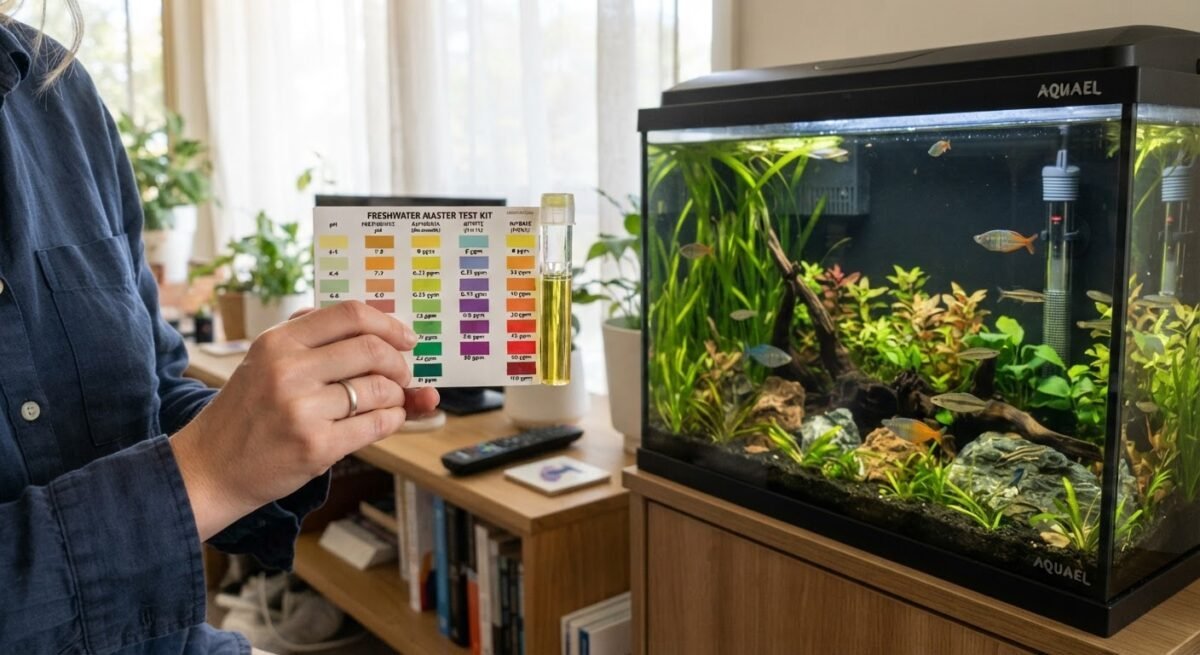
Use a liquid test kit or multi-test strips, following the instructions exactly. Test weekly or fortnightly on an established tank, and any time fish look unwell or you’ve changed rocks, wood or substrate. See our guide to testing fish tank water and our water test kit picks.
Frequently Asked Questions
What pH should a fish tank be for tropical fish?
Usually 6.5 to 7.5 for common community tropicals. South American species like tetras lean lower, while livebearers and African cichlids prefer higher.
What should the pH level be in a fish tank?
Most freshwater fish do well from 6.5 to 8.0. Aim for stable and species-appropriate rather than a fixed 7.0.
What is pH in a fish tank?
It’s a measure of how acidic or alkaline the water is, from 0 to 14, with 7.0 neutral. Each whole number is a tenfold change.
Is 8.0 pH too high for a fish tank?
Not for most freshwater fish, and it suits African cichlids and livebearers well. It is worth an ammonia test, because ammonia is more toxic as pH rises.
How do I fix the wrong pH in my fish tank?
First check whether it needs fixing. If it does, adjust slowly, using KH as your guide. See how to raise or lower pH in the linked guides.
