

Dr Tim’s One & Only has the best reputation and FritzZyme 7 is the better price per litre, but independent evidence for every bottle is weak. Only one controlled study found a product that beat an untreated tank, and I could not confirm that product, Tetra SafeStart, in an Australian shop. Mature filter media from a healthy tank remains the proven free option.
The best beneficial bacteria for aquarium use are bottled cultures of nitrifying bacteria that convert toxic ammonia into nitrite and then into nitrate, sold to speed up a new tank cycle or rebuild it after medication or a filter clean. Bottles are optional insurance, not a shortcut.
Two kinds are sold. Live liquid cultures such as Dr Tim’s and FritzZyme 7 claim to contain living nitrifiers, and spore-based products such as Seachem Stability rely on dormant Bacillus spores that may or may not nitrify. API Quick Start sits in between as a widely stocked liquid that never names its bacteria.
The numbers that matter are the dose per litre, the storage limit and the batch expiry. A tank is cycled when ammonia and nitrite both read zero within 24 hours of an ammonia dose, with nitrate present, whatever the label promises.
This guide covers four bottled bacteria sold in Australia for freshwater tanks. It leaves out marine products and it also leaves out cycling with mature filter media, which you can read about in the tank cycling guides on this site.
The only controlled study I found (Scagnelli and colleagues, Journal of Exotic Pet Medicine, 2023, six 10-gallon tanks over 14 days) reported that only Tetra SafeStart produced significantly lower ammonia than an untreated control. I could not read the full paper, so I cannot name the other brands tested, and the study did not report product age. I also could not confirm an Australian price or stockist for Tetra SafeStart Plus, so it is not listed below.
Best Beneficial Bacteria for Aquarium in Australia, Compared
| Product | Type | Best For | Key Spec |
|---|---|---|---|
| Dr Tim’s One & Only Freshwater | Live liquid culture | New tanks and rebuilds, budget flexible | 2 oz treats 114 L, refrigerate for a year |
| FritzZyme 7 Freshwater | Live liquid culture | Best price per litre of a live product | 119 ml per 38 L for a new tank |
| Seachem Stability | Spore-based liquid | Heat tolerance and wide stockists | 6-year shelf life, no fridge |
| API Quick Start | Liquid, bacteria not named | Cheap and widely sold | 10 ml per 38 L |
How I Compared These Bacteria
Prices, doses and storage limits come from Australian listings and manufacturer pages checked on 29 September 2026. For efficacy I used the 2023 Scagnelli study through secondary write-ups, and hobbyist test reports at aquariumscience.org and The Scientific Fishkeeper. Reddit, FishLore and the Aquarium Co-Op forum blocked me, so I read no owner threads directly. productreview.com.au, CHOICE and Canstar Blue show no coverage of this category. The ACCC recall search surfaced nothing relevant, though I did not browse the full recall database.
1. Dr Tim’s One & Only Freshwater – Best-regarded live bacteria if you can find it in stock
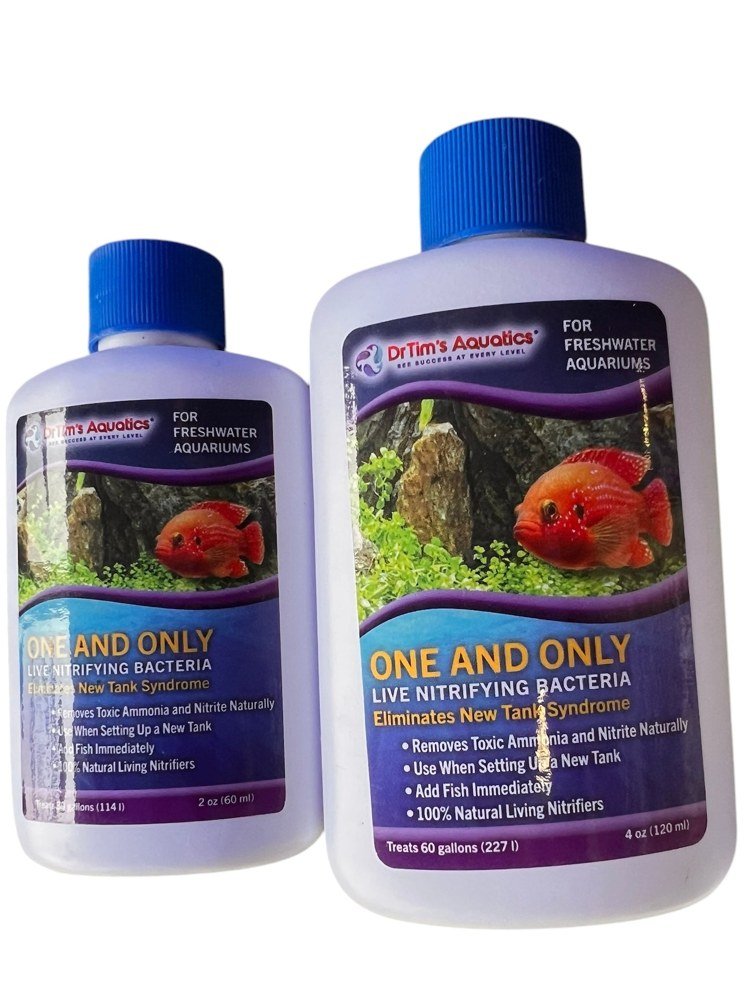
This is the product hobbyists most often call the proven one, and it is the one I would pick if price were no object. The maker states one 60 ml bottle treats 114 L, and Aquaristic Online lists it at $47 in stock. The maker’s own guide says to dose over the filter media and to dechlorinate first, with any conditioner except those containing aldehydes.
The evidence is modest. Aquariumscience.org, a hobbyist experimenter site, reports statistically significant improvement at 90 percent confidence in its third test, possibly from fresher stock. The Scientific Fishkeeper says no reliable independent studies exist for the brand. I could not confirm it was part of the 2023 study either way.
Cost and supply are the drawbacks. At about $0.41 per litre treated it is more than double FritzZyme 7 below, and Aquarium Gallery and Reef Secrets both showed it sold out when I checked. The Reef Secrets freshwater page also carries copy that reads like saltwater text, so ignore its dosing.
Pros
- Best reputation among hobbyists
- Live culture with clear storage limits from the maker
- Dosed by tank volume, 60 ml per 114 L
Cons
- About $0.41 per litre treated, roughly double FritzZyme 7
- Sold out at two Australian shops on the check date
- No reliable independent studies exist for this brand (Scientific Fishkeeper)
2. FritzZyme 7 Freshwater – Best value live nitrifying bacteria
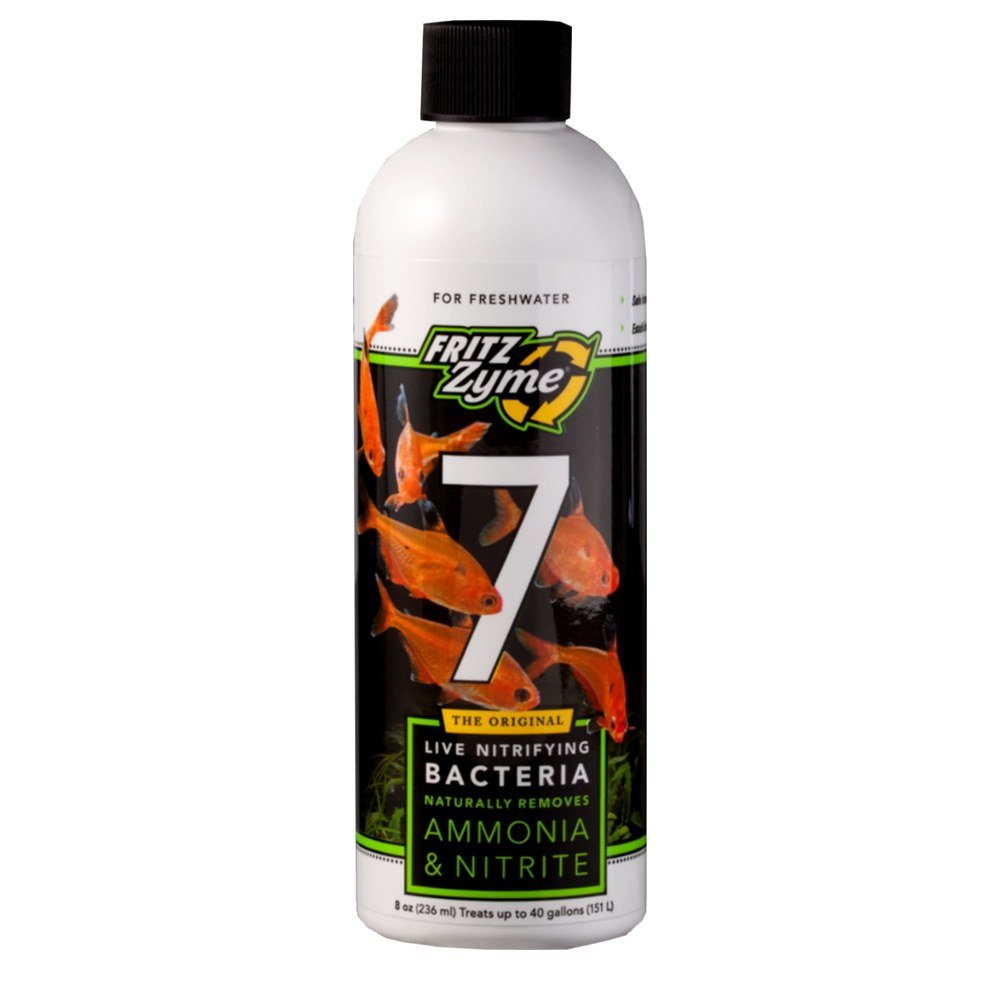
FritzZyme 7 is the live culture I would buy on price. The 473 ml bottle costs $25.95 at Aquarium Kingdom, in stock with an expiry of July 2027, and my arithmetic on Fritz’s new-tank dose puts it near $0.17 per litre, about 40 percent of Dr Tim’s. Fritz and Roxy Aquarium both say to remove chlorine and chloramine first, and Fritz says to turn off any UV unit for four to five days.
Independent evidence is mixed. Aquariumscience.org says it failed in its author’s tests and describes criticism of the maker’s marketing claims, though I did not see the underlying documents. It also sells out, and Roxy showed it unavailable on the check date.
Pros
- Around $0.17 per litre on my arithmetic
- 18-month shelf life with no refrigeration
- Clear instruction to dechlorinate and disable UV first
Cons
- Failed in the aquariumscience.org author’s tests
- New-tank dose is large, about 3 ml per litre
- Roxy Aquarium showed it sold out on the check date
3. Seachem Stability – Best for heat tolerance and easy stockists
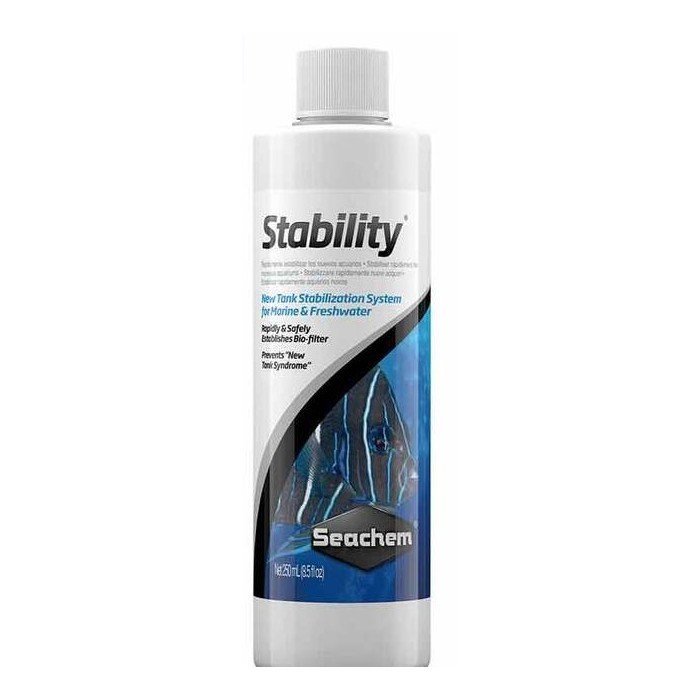
This is the easiest bacteria bottle to actually buy. Petbarn lists 250 ml at $24, with 4.9 out of 5 from 32 on-site reviews, and Aquarium Kingdom sells it in a Prime combo for $36.99. Seachem states a six-year shelf life with no refrigeration, so it best survives an Australian summer courier run.
The catch is what it actually contains. Aquariumscience.org reports Seachem’s own testing took 32 days to cycle, and critics say Bacillus spores are not nitrifiers, though one of the researchers quoted founded a competitor. For a 200 L tank, the first-week course uses about 22 of the bottle’s 50 capfuls, by my arithmetic.
Pair it with a proper conditioner from the best water conditioners for Australian tap water guide, and test as you go.
Pros
- Six-year shelf life, no fridge needed
- Sold by mainstream Australian retailers
- Roughly $0.05 per litre for the first-week course, on my arithmetic
Cons
- Nitrifier content disputed, since Bacillus spores are not nitrifiers (forum critics)
- Seachem’s own test took 32 days to cycle (aquariumscience.org)
- The 4.9 out of 5 rating is hosted by the retailer, not independent
4. API Quick Start – Best cheap bottle, with a weak test record
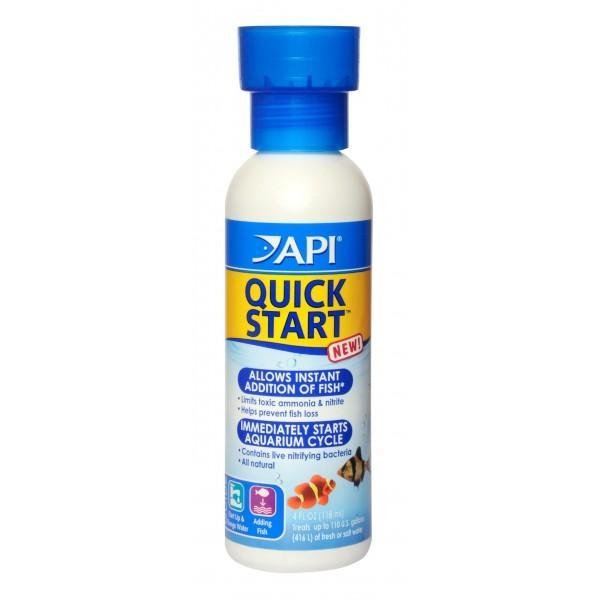
Quick Start is on nearly every shelf, so it is the one you can grab today. Habitat Pet Supplies lists the 118 ml bottle at $25.99, and API says to dose it after medicating or after changing filter media. The dose works out near $0.06 per litre.
Evidence is poor. Aquariumscience.org reports it failed in testing alongside Microbe-Lift and Nutrafin Cycle, with no significant difference from untreated controls. API does not name the bacteria or give a shelf life, and its page says nothing about chloramine. Treat it as a fallback, not a first choice.
Pros
- Stocked almost everywhere
- Lowest cost per litre treated, about $0.06
- Clear guidance to use after medication or filter changes
Cons
- Failed in aquariumscience.org testing with no benefit over controls
- Bacteria and shelf life are not stated
- Page says nothing about chloramine
How to Choose Beneficial Bacteria for Your Aquarium
Start with what already works. Mature filter media or a sponge from a healthy tank is the best free seed, and aquariumscience.org reports it cycles a tank in about 6 to 12 days, against four weeks or more with ammonia alone and four to six weeks with bottled bacteria. See the best sponge filter for aquarium guide for a media source you can keep running in a spare tank, and the filter media guide for what to keep when you clean.
- New tank with no seed media: FritzZyme 7 for price, Dr Tim’s if you want the best reputation.
- After medication or a filter clean: any live culture plus daily ammonia and nitrite tests for a week.
- Dechlorinate first: Fritz and Dr Tim’s both say chlorine and chloramine must be removed.
- Turn off UV, ozone or a skimmer for four to five days after dosing (Fritz, Seachem).
- Check the batch expiry on the bottle, because stock that sat on a hot shelf may be dead.
- Test with a proper kit from the best aquarium water test kits guide, and stop calling the tank cycled until ammonia and nitrite both read zero.
Dr Tim’s states the bottle must never exceed 35 C, and a courier van in a February heatwave can pass that. Buy from a shop with fast turnover, check the expiry date, and avoid mid-summer delivery if you can. I could not verify which Australian cities use chloramine, so check your own water utility’s report before choosing a conditioner.
Related Cycling and Water Care Guides
Bacteria only help when the rest of the water care is right, so these guides on this site cover the other half.
- Best water conditioners for Australian tap water
- Best aquarium water test kits in Australia
- Best sponge filter for aquarium use in Australia
Frequently Asked Questions
Do bottled beneficial bacteria actually work?
The evidence is weak. The only controlled study I found reported that just one product, Tetra SafeStart, beat an untreated control in 14 days, and hobbyist tests of other brands are mixed. Bottled bacteria are optional insurance, not a shortcut, and seeding from mature filter media is the proven free alternative.
How long does it take to cycle a tank with beneficial bacteria?
With mature filter media from an established tank, about 6 to 12 days. Ammonia alone takes four weeks or more, and bottled bacteria typically land around four to six weeks, according to aquariumscience.org. A tank is cycled when ammonia and nitrite both read zero within 24 hours of an ammonia dose, with nitrate present.
Do I need to dechlorinate before adding bacteria?
Yes. Fritz and Dr Tim’s both say to remove chlorine and chloramine first, and Dr Tim’s warns against conditioners containing aldehydes. Chlorine or chloramine can kill the live bacteria you just added. Check with your local water utility whether your tap water uses chloramine, then dose a suitable conditioner.
When are bottled bacteria most useful?
After medicating a tank, after cleaning or replacing filter media, and when adding a lot of new fish at once. Manufacturers make these claims and independent tests do not prove them. Test ammonia and nitrite daily for a week afterwards, and keep doing water changes if either reads above zero.
Can a bacteria bottle spoil in summer heat?
Some can. Dr Tim’s states the bottle must never exceed 35 C, with about six months at room temperature or a year refrigerated, and a parcel left in a hot Australian van can breach that. Check the batch expiry and buy from a busy shop. Spore-based Stability tolerates heat better, though its nitrifier claim is disputed.
If you want the best-regarded live culture and can find it in stock, Dr Tim’s One & Only is the pick, and FritzZyme 7 is the better value at roughly $0.17 per litre. Seachem Stability is the easy, heat-tolerant buy, though its nitrifier claim is disputed. None of them beats the proven free option of mature filter media, so use a bottle as insurance, dechlorinate first, and let your ammonia and nitrite readings decide when the tank is ready.
