
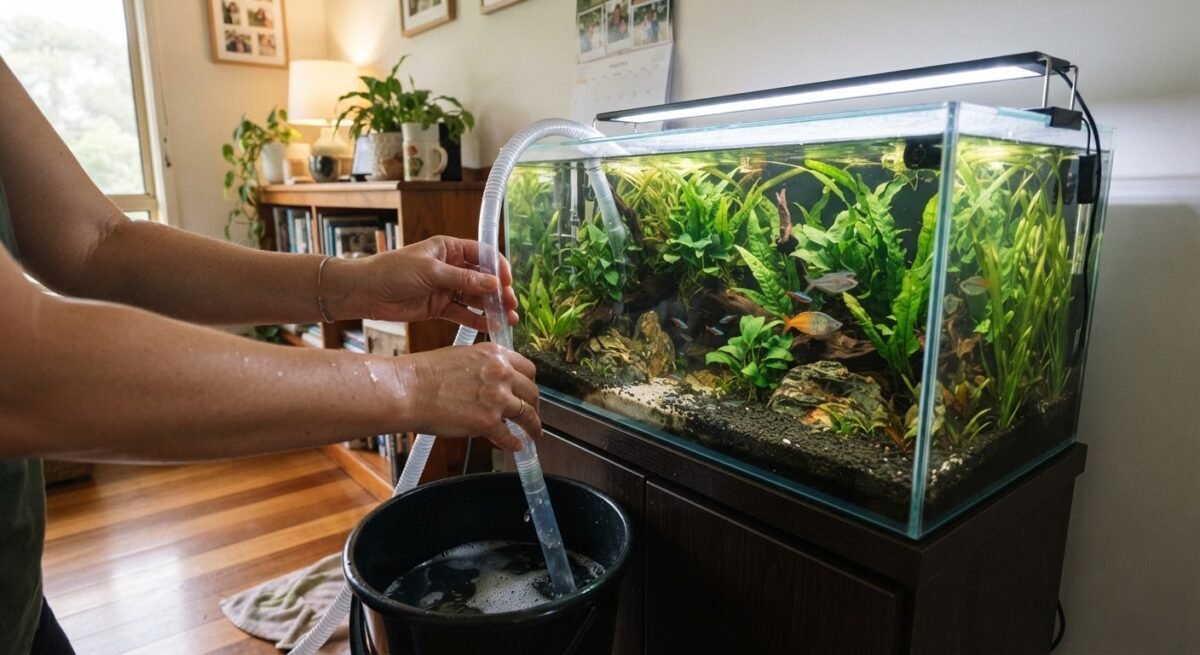
Nitrite should read 0 ppm. To bring it down, change 25 to 50 per cent of the water with conditioned, temperature-matched water, cut feeding, add aeration and retest daily. Those steps only dilute it. The real fix is a mature filter, which takes a few weeks in a new tank.
Here’s how to reduce nitrite in fish tank water. Test to confirm the reading, then do a large partial water change with treated water and stop feeding for a day or two. Add an air stone or extra surface movement, and retest daily. Nitrite blocks fish blood from carrying oxygen, so act the same day. Then fix the cause, or it will be back.
This guide sits in our Ammonia & Nitrate guides and owns the fix. For reading the number, see how to test fish tank water.
Why Nitrite Is Dangerous
Nitrite is the middle step of the nitrogen cycle: one group of bacteria turns ammonia into nitrite, and another turns nitrite into nitrate. Auburn University extension explains that nitrite enters the blood through the gills and converts haemoglobin into a form that can’t carry oxygen. The blood turns brown, and fish show low-oxygen stress even in well-aerated water. That’s why it’s called brown blood disease.
The safe reading is zero. UF/IFAS Extension says nitrite is toxic to fish at levels as low as 0.10 mg/L. Signs include gasping at the surface, fast gill movement and fins held tight to the body.
How to Reduce Nitrite in Fish Tank Water: The First Hour
- Confirm the reading. Retest, and check ammonia at the same time. Our ammonia testing guide covers the kit steps.
- Change 25 to 50 per cent of the water. Guides range from a 25 to 50 per cent change to 50 per cent daily until nitrite reaches zero. Use conditioned water at the tank’s temperature. The water change guide has the steps.
- Cut feeding for a day or two. Uneaten food and waste feed the ammonia that becomes nitrite. Siphon out any waste on the bottom.
- Add aeration. Higher oxygen improves survival when blood oxygen is compromised. An air stone or a filter outlet breaking the surface both help.
- Don’t add fish until nitrite is back at zero.
- Retest after 24 hours and repeat the change if it’s still up.
Can Salt Help?
Sometimes, as a short-term shield. Chloride from salt competes with nitrite at the gill surface, so it reduces how much nitrite gets into the blood. It doesn’t remove nitrite from the water. Extension guidance suggests keeping chloride around 10 times the nitrite level. Published salt doses differ a lot between sources, so this guide prints no single figure. Follow the label of an aquarium salt and dose it into treated water, not straight onto the fish.
- Scaleless fish such as corydoras are more sensitive to salt.
- Plants tolerate low doses better than high ones.
- Shrimp and snails: No reliable guidance turned up, so treat salt as unsafe for them unless a trustworthy source for your species says otherwise.
- Long term: salt is a bridge, not a cure. It also builds up unless you remove it with water changes.
What About Conditioners That Claim to Detoxify Nitrite?
One leading maker says its conditioner binds nitrite so bacteria can still use it, for up to about 48 hours, and it can be re-dosed. It doesn’t remove nitrite. Other sources dispute that these products do anything to nitrite at all. Treat them as a temporary bridge at most, and keep the water changes going. Very high doses can also lower oxygen, so add an air stone.
Fix the Cause So It Stays Down
Nitrite disappears when nitrite-eating bacteria are established, so every long-term fix is about protecting or building them.
| Likely cause | What to do |
|---|---|
| New tank, still cycling | Nitrite is expected. Keep testing and changing water if fish are in. See the cycling timeline |
| Overfeeding or overstocking | Feed what fish eat in a minute or two, and reduce numbers |
| Filter cleaned too hard, or media replaced | Rinse media only in tank water and never replace it all. |
| Untreated tap water | Use a conditioner that names chloramine. Chlorine and chloramine kill the bacteria |
| Low pH or very soft water | Test pH and KH. Low pH slows the bacteria, according to one retailer guide |
| Cold water | In cool water the ammonia-eating bacteria outpace the nitrite-eaters, so nitrite builds. Keep the tank warm and steady |
| Dead fish or decaying food | Remove it and change water |
Many Australian supplies use chloramine, at least in some areas, so check with your water provider.
How Long Does It Take to Come Down?
In a new tank, usually a few weeks, sometimes longer. Practical Fishkeeping puts filter maturity at 4 to 6 weeks, and UF/IFAS at six to eight weeks for a new biofilter. In an established tank, nitrite should fall within days once you’ve removed the cause, keep testing daily until it does.
Common Mistakes
- Relying on a bottle of detoxifier instead of water changes.
- Doing one water change and not retesting.
- Adding more fish to a tank with any nitrite.
- Dosing salt without checking fish and plants.
- Cleaning the filter hard in a panic, which removes the bacteria you need.
When to Get Help
Ask a local aquarium shop to test a sample, or see a fish vet, if nitrite stays above zero after several days of water changes. Do the same if fish are gasping or hanging at the surface.
Related Guides
Keep reading on the same topic:
Frequently Asked Questions
How to lower nitrites in a new fish tank?
Change water if fish are in the tank, feed lightly and be patient. Nitrite is part of a normal cycle, and it falls once the second group of bacteria establishes.
How much water should I change to lower nitrite?
25 to 50 per cent is the usual range, repeated daily while nitrite is above zero. Use treated water at the same temperature.
How to reduce nitrite in fish tank naturally?
Feed less, remove waste, add live plants, protect the filter bacteria and keep water changes regular. Nothing works faster than dilution plus a mature filter.
Does salt reduce nitrite?
It doesn’t remove it. Chloride helps protect fish gills from nitrite, and doses vary by source. Check your fish and plants first.
What is a safe nitrite level?
Zero. Even 0.10 mg/L can be toxic, and 0.25 mg/L can stress sensitive fish.
