
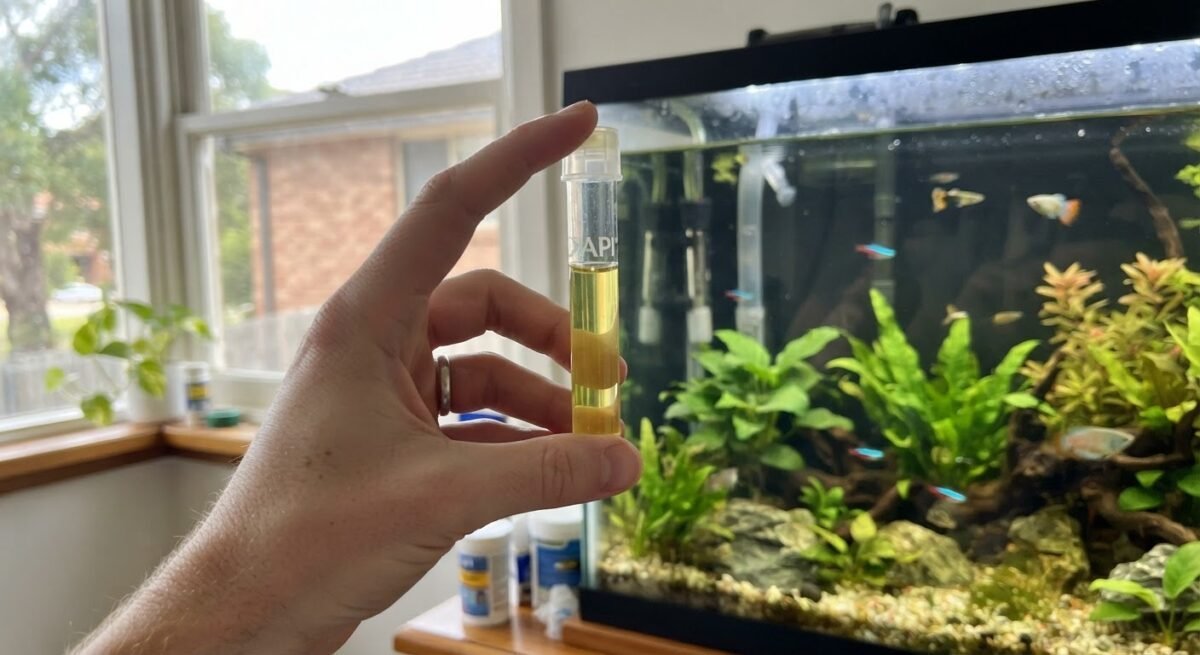
Most guides quote about 4 to 6 weeks to cycle a fish tank, but real tanks range from roughly 2 weeks to 2 months or more. It’s finished when a dose of about 2 ppm ammonia drops to 0 ammonia and 0 nitrite within 24 hours, with nitrate showing. The calendar doesn’t decide it. The test does.
How long to cycle a fish tank depends on your tank, and no honest guide can give one date. Most quote around 4 to 6 weeks for a fishless cycle, and published figures stretch from about 2 weeks to several months. Temperature, pH, how much bacteria you start with and whether you seed the filter all move the number. The finish line is a test result, not a week count.
This page covers the timing and the signs. For the dosing steps, see our guide onhow to cycle a fish tank. More background sits in our Tank Cycling guides.
The Milestones, in Order
A tank cycles when beneficial bacteria grow large enough to convert ammonia into nitrite and then into nitrate. Ammonia is the toxic waste from fish and food. Nitrite is the second, also toxic, stage, and nitrate is the far less harmful end product. Each stage shows up on a test in a set order, even though the dates vary.
| Stage | Ammonia | Nitrite | Nitrate | What it means |
|---|---|---|---|---|
| 1. Start | Rising | 0 | 0 | Ammonia source added, bacteria starting to grow |
| 2. Ammonia converters established | Falling | Rising | Starting to show | First bacteria group is working |
| 3. Nitrite converters established | Near 0 | Falling | Rising | Second group is catching up |
| 4. Cycled | 0 | 0 | Present | Filter can process a full dose in 24 hours |
How Long to Cycle a Fish Tank: What Changes the Timeline
Sources disagree because tanks do. A small 2025 study monitored three home aquariums for 12 weeks. Ammonia was undetectable by weeks 2 to 3 in two tanks, while the third didn’t get there until weeks 6 to 8. Three tanks is a small sample, but it shows how far one setup can differ from another.
| Factor | Effect on the cycle | What to do |
|---|---|---|
| Temperature | Nitrifying bacteria grow best around 25 to 30 degrees C and slow in colder water | Run the heater and keep the tank steady. Hotter is not always better |
| pH | Cycling can stall if pH sinks. Suppliers give thresholds from about pH 6.0 up to 7.0 | Test pH. If it drops, a partial water change with treated water can restore it |
| KH (alkalinity) | Bacteria use up buffer as they work, which lowers pH. One maker suggests a starting level of 100 to 200 mg/L, roughly 5.6 to 11 dKH | Test KH if pH keeps falling |
| Oxygen | Nitrification slows when dissolved oxygen is low | Keep good surface movement |
| Seeding | Used filter media or gravel from a healthy tank brings bacteria that are already working | Ask a local hobbyist or shop for a squeezed-out sponge or a handful of media |
| Live plants | Hobby guides list them as a helper | Add hardy plants early |
The 25-to-30 degrees C range comes from one bacteria maker, so read it as a guide. Hobby sources also disagree on the exact pH cut-off, which is why the table gives a spread.
Do Bottled Bacteria Speed It Up?
The evidence is thin and product-specific. A controlled study of five quick-start products used six tanks, one per product plus a control. Four of the five did not reduce ammonia over 14 days, and the authors did not recommend them as a sole method. One tank per product is a small test, and retailers and some hobby guides report faster results. Freshness matters, so check the date. Seeded media from a healthy tank has the better track record.
How to Tell Your Tank Is Cycled: The 24-Hour Test
- Dose ammonia to about 2 ppm and test to confirm the number. Don’t go above 5 ppm, which can stall the bacteria.
- Wait 24 hours with the filter running and the heater on.
- Test ammonia, nitrite and nitrate. Our guides to testing fish tank water and testing for ammonia cover the steps.
- Check the result. Zero ammonia, zero nitrite and some nitrate means the filter handled a full dose overnight. If not, repeat daily.
How Long Does a Fish-In Cycle Take?
It’s slower and riskier, because fish sit in the ammonia and nitrite while the bacteria catch up. Hobby guidance is to add only a few fish, roughly one small fish per 38 litres, feed very lightly and build up over 4 to 6 weeks. Test every day or two, and change water whenever ammonia or nitrite is detectable. Fishless is the kinder option when you can wait.
What Happens If You Add Fish Too Early
Ammonia burns gills, and nitrite interferes with how blood carries oxygen. Hobbyists call the result new tank syndrome: lethargic fish, gasping at the surface, and losses. Bacteria grow to match the food supply, so a cycle finished for three fish won’t cope with thirty. Add stock gradually, and see why a new tank goes cloudy if you see a milky bloom in the first fortnight.
The Australian Angle
Warm summers help. A tank sitting at 25 to 28 degrees C without much heater effort tends to move faster than the same tank in an unheated southern room in winter. That is logic from the temperature evidence, not measured Australian cycle times.
Always treat new water with a conditioner that names chloramine. Many Australian supplies use it, at least in some areas, and it combines chlorine with ammonia. A conditioner that binds ammonia can leave a test kit reading ammonia even when the fish are safe, so read the label and see our ammonia testing guide.
When the Cycle Stalls
- Ammonia hasn’t moved for two weeks: check temperature, pH and KH first.
- Nitrite stays high while ammonia is zero: nitrite converters take longer, so hold steady and keep testing.
- pH has dropped below 7: do a partial water change with treated water and retest.
Related Guides
Keep reading on the same topic:
Frequently Asked Questions
How long to cycle a fish tank before adding fish?
Until the 24-hour test passes, which is often 4 to 6 weeks but can be faster or slower. A tank that’s been running for a set number of weeks isn’t necessarily ready. Test rather than count days.
Can I speed up the cycle?
Yes, mainly by seeding with media from an established tank, keeping the water warm, and adding hardy plants. Bottled bacteria are less proven, so don’t rely on the label alone.
How long does it take to cycle a fish tank with fish?
Around 4 to 6 weeks of careful feeding and testing, with daily water changes if ammonia or nitrite appear. It is harder on the fish than a fishless cycle.
Does a small tank cycle faster?
There’s no reliable evidence either way. Small tanks swing faster in ammonia and pH, so problems show up sooner and need quicker action.
Why is my new tank cloudy?
It’s usually a bacterial bloom, common in the first two weeks. Leave the filter running, feed lightly and test.
