
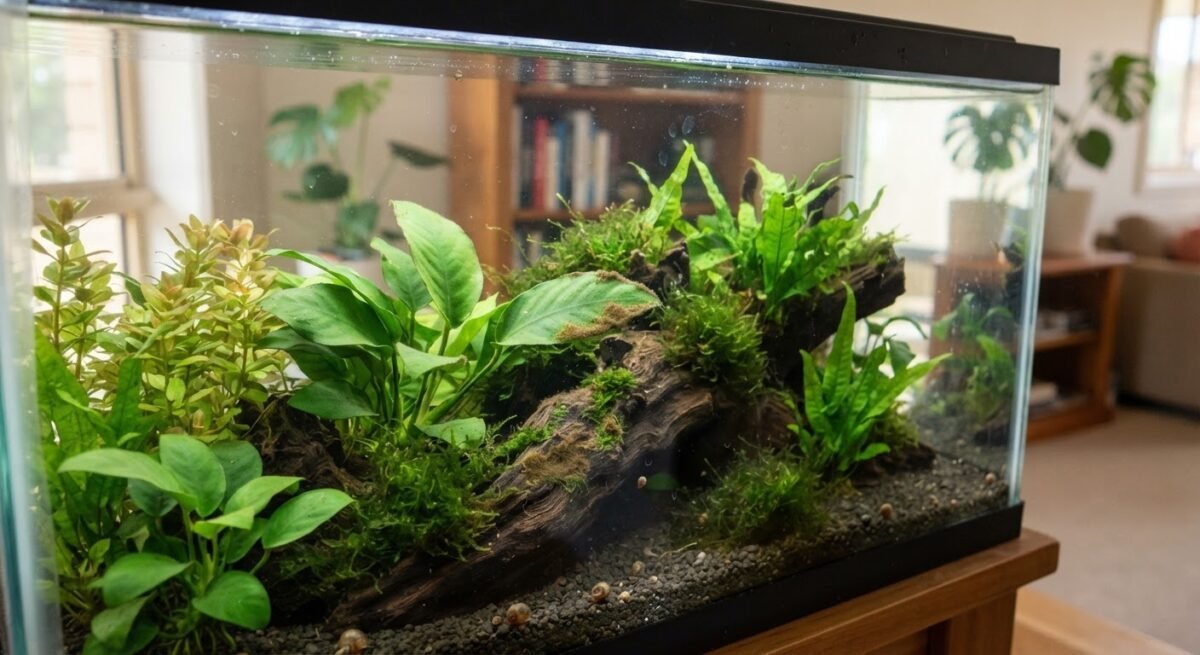
Hardy beginner plants are anubias, java fern, vallisneria, cryptocoryne and java moss. Cover about half the tank with plants and decor and run the light for 10 hours a day at most. Never buy or release salvinia, water hyacinth or cabomba, which are restricted or prohibited in parts of Australia.
What plants can I put in my fish tank? Start with hardy live plants that need little light, such as anubias, java fern, vallisneria, cryptocoryne and java moss. Tie the first two to wood or rock, push the others into the substrate, and buy them from an aquarium shop, because a few common water plants are banned weeds in parts of Australia.
Live plants do a few jobs at once. They give fish cover, they soak up some of the nitrate that builds up between water changes, and RSPCA Australia notes that live plants absorb waste products from the water. They won’t replace a filter or a water change, though. The Live Plants guides go deeper on each species.
What Plants Can I Put in My Fish Tank? Five Easy Options
These five suit a first planted tank because they cope with modest light and don’t need a special substrate or extra CO2. Where a plant goes in the tank depends on how it feeds.
| Plant | Where it goes | How to plant it | Light |
|---|---|---|---|
| Anubias | Mid-ground, on wood or rock | Tie or glue the rhizome to hardscape; keep it above the substrate | Low |
| Java fern | Mid-ground, on wood or rock | Same as anubias: attach it, never bury the rhizome | Low |
| Vallisneria | Background | Push the roots into the substrate, crown just above the surface | Low to moderate |
| Cryptocoryne | Mid to foreground | Plant in the substrate and leave it alone, because it sulks when moved | Low to moderate |
| Java moss | Anywhere | Tuck or tie it onto wood, rock or decor | Low |
The light column is a general guide, not a measurement, because your tank depth, lid and light unit all change it. If a plant looks pale or stretched, move it before you buy a brighter light.
Check the Law Before You Buy Aquatic Plants
Some popular water plants are banned weeds in parts of Australia, and the rules differ by state and change over time. In Victoria it’s illegal to buy or sell water hyacinth, salvinia, lagarosiphon or alligator weed, all listed by Agriculture Victoria as state prohibited weeds. In Queensland, cabomba is a restricted invasive plant that you must not give away, sell or release. In Tasmania, hornwort is a declared weed and its sale is prohibited. Check your own state’s biosecurity department before you buy.
Never tip old plant trimmings into a creek, drain or pond. Bag them and put them in the bin, because that is how aquarium weeds got out in the first place.
How to Grow the Plants You Put in Your Fish Tank
- Buy from an aquarium shop. RSPCA Australia advises buying live plants only from aquarium stores, so you don’t bring in parasites or disease.
- Rinse and inspect them. Rinse each plant in a bucket of treated water and pick off dead leaves. Look for snail eggs, which are the usual stowaway.
- Plant by type. Anubias and java fern attach to hardscape with cotton thread or a dab of gel superglue. Vallisneria and cryptocoryne go into the substrate with the crown above the surface. Java moss can be tucked in anywhere.
- Keep the light on a timer. RSPCA Australia says lights should run for a maximum of 10 hours a day, and fish need at least 8 hours of darkness. More light mostly grows algae, so start shorter and add time slowly.
- Feed the plants lightly. Fish waste supplies some nutrients, and a liquid fertiliser or root tab tops up the rest. Anubias and java fern feed mainly through their leaves, while vallisneria and cryptocoryne feed through their roots.
- Trim as they grow. Remove yellow leaves and cut back overgrown stems, so rotting leaves don’t add ammonia.
If the plants still struggle, the low light plants roundup and the beginner plants roundup list options that forgive mistakes.
How Many Plants Should You Put in Your Fish Tank?
Aim for about half the tank covered by plants and decor, leaving open water for swimming. That figure comes from RSPCA Australia’s tropical fish guide, and it holds up in practice, because a wall of leaves hides the fish and blocks the flow.
Plants also help with nitrate. They take it up as fertiliser, but the plant mass needed to change a heavily stocked tank is large, so keep lowering nitrate with water changes in your routine.
Match the plants to the fish, too. Bottom feeders that dig can uproot cryptocoryne, and a goldfish will shred soft leaves. Bettas do best with soft, broad leaves, covered in the betta plants guide. Keeping some fish species is restricted in parts of Australia, so check your state Fisheries or Biosecurity department before you buy any.
Common Mistakes
- Burying the anubias or java fern rhizome, which rots it. Attach it instead.
- Turning the light up when a plant struggles. Extra light without nutrients feeds algae, not the plant.
- Buying a mystery floating plant online. Some of the banned weeds are sold as ornamental pond plants, so buy from an aquarium shop.
- Planting every space. Fish need open water, and dense growth can trap detritus.
Related Guides
Keep reading on the same topic:
Frequently Asked Questions
What plants can I put in my fish tank without special lighting?
Anubias, java fern and java moss cope with low light. Vallisneria and cryptocoryne also manage under a standard tank light if they get a few weeks to settle. None of them needs added CO2.
Can I put any aquarium plant in my tank in Australia?
No. Some water plants are banned or restricted in parts of the country, including salvinia, water hyacinth, cabomba and, in Tasmania, hornwort. Check your state biosecurity department before you buy.
Do live plants replace a filter?
No. Plants absorb some waste, but the filter still hosts the bacteria that turn ammonia into nitrite and then nitrate. Keep the filter and the water changes.
Are live plants better than artificial ones?
Both reduce stress by giving cover, according to RSPCA Australia, but live plants also take waste products out of the water. Artificial plants need a wipe now and then, and should have no sharp edges.
How do you keep plants in a fish tank from dying?
Attach rhizome plants instead of burying them, keep the light to 10 hours or less, and feed lightly. Most early plant deaths come from a buried rhizome or too much light.
