
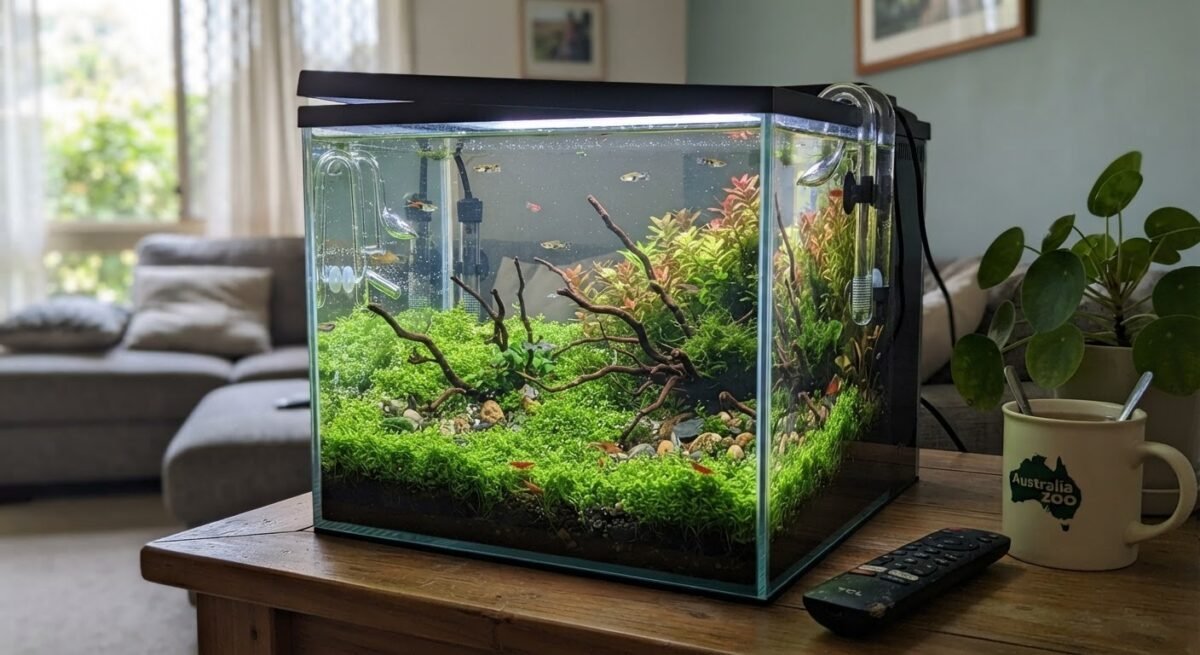
The best aquarium carpet plants are low, spreading foreground species that knit together into a lawn across the substrate, and the right one depends far more on your light and CO2 than on how pretty the photo looks. They fall into three groups: runner carpets such as Marsilea hirsuta, grasses such as dwarf hairgrass, and tiny creeping stem plants such as Monte Carlo and dwarf baby tears.
The number that matters is CO2. Tropica rates Marsilea hirsuta and Staurogyne repens as low CO2, Monte Carlo and micro sword as medium at 6 to 14 mg/L, and dwarf baby tears as high at 15 to 25 mg/L. That one spec separates a carpet that fills in from a patch of melted stems.
This list covers six freshwater carpet plants sold in Australia, all researched rather than grown in my own tanks. It leaves out mosses and dwarf sagittaria, for reasons explained below. For general plant choices, start with the best aquarium plants for beginners.
Marsilea hirsuta is the safest carpet for most Australian tanks: it is native, easy, and needs little light or CO2, though it is slow. Monte Carlo is the best mid-tech choice. Dwarf baby tears is the famous one and the hardest, and it fails without strong light and CO2.
The Best Aquarium Carpet Plants, Compared
| Plant | Type | Best For | Key Spec |
|---|---|---|---|
| Marsilea hirsuta | Runner carpet | Low-tech tanks and beginners | Low light, low CO2, Australian native |
| Monte Carlo (Micranthemum tweediei) | Creeping stem carpet | Medium light tanks | Medium light, CO2 6 to 14 mg/L, 3 to 5+ cm |
| Dwarf Hairgrass (Eleocharis) | Grass carpet | Fine, lawn-like foregrounds | Moderate to strong light, CO2 recommended |
| Staurogyne repens | Bushy low carpet | Low light tanks needing easy cover | Low light, low CO2, 3 to 10+ cm |
| Micro Sword (Lilaeopsis brasiliensis) | Grass-like carpet | Slow, low-maintenance lawns | About 0.5 W/L, CO2 6 to 14 mg/L, 3 to 5+ cm |
| Dwarf Baby Tears (HC Cuba) | Creeping stem carpet | High-tech nano tanks | High light, CO2 15 to 25 mg/L |
How I Compared It
I have not grown these six myself, so every pick is labelled Researched, as promised on the How We Test page. Light, CO2, height and difficulty come from Tropica’s plant pages. Owner experience comes from a September 2025 low-tech carpet test at Glass Box Diaries, a 2020 low-light roundup at The Good Algae and a 2023 dwarf baby tears care sheet at Aquariadise. Reddit could not be read directly and productreview.com.au has no plant listings. Prices and portion sizes were checked on Aquafy and Micro Aquatic Shop on 29 September 2026.
1. Marsilea hirsuta – Best low-tech carpet for Australian tanks
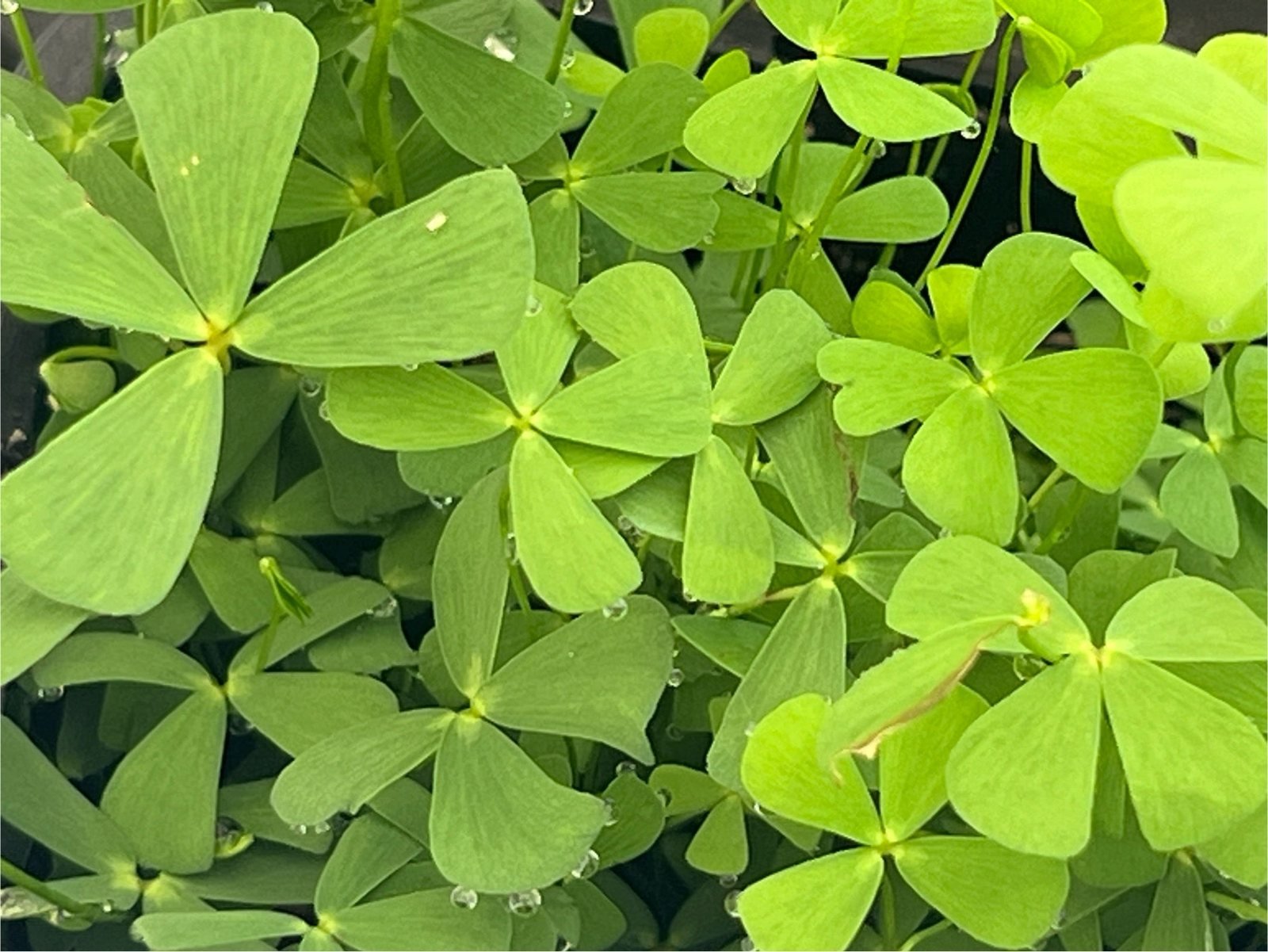
Marsilea hirsuta is the one plant on this list that comes from Australia, and Tropica rates it easy, with low light and low CO2 demand and runners that colonise the substrate. It starts with clover-like four-lobed leaves and, depending on your tank, either settles into a low lawn of single leaves or grows two-, three- or four-lobed leaves at varying heights. Tropica quotes 5 to 20+ cm after two months, so expect to trim it.
The catch is speed. Glass Box Diaries, testing carpets in a budget low-tech tank in 2025, called it very slow-growing and said it needs patience. Aquafy sells it as an emersed rooted plant with 10 to 15 leaves for $9.95 and says it takes a few weeks underwater to transition to a carpeting plant, while Micro Aquatic Shop charges $16.00 for six emersed leaves. Against Monte Carlo below, Marsilea is slower but far more forgiving.
Pros
- Tropica rates it easy with low light and low CO2 demand
- Australian native, sold cheaply from about $9.95
- Spreads by runners and needs no special substrate
Cons
- Glass Box Diaries called it very slow-growing in low-tech conditions
- Height varies from 5 to 20+ cm, so it is not a tidy short lawn without trimming
- Emersed plants need a few weeks to adjust underwater
2. Monte Carlo (Micranthemum tweediei) – Best mid-tech carpet with medium light
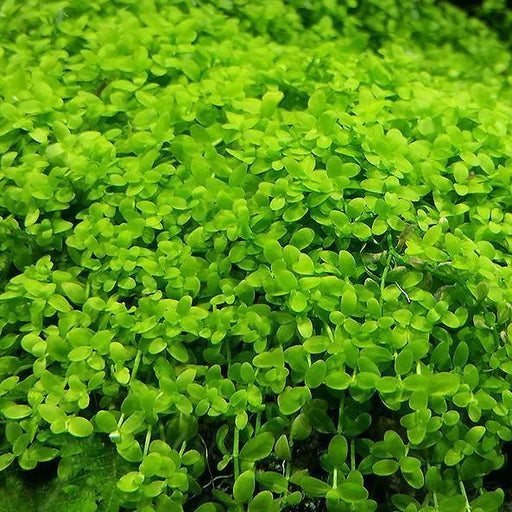
Monte Carlo is the carpet most people picture: small round fresh-green leaves on creeping stalks that Tropica rates medium for difficulty, light and CO2, growing 3 to 5+ cm in two months. It tolerates partial shade but only compacts under strong light and CO2. Tropica also calls it the less demanding substitute when dwarf baby tears proves too fussy.
It can still fail. Glass Box Diaries had its Monte Carlo melt away, blaming keeper error and competition from other plants, and said it wants stronger light than most carpets. Aquafy sells a 6×6 cm flat portion for $10.95, about 30 cents per square centimetre of starting stock, while Micro Aquatic Shop charges $14.95 for a pot and $18.00 for a tissue culture cup. Compared with dwarf hairgrass below, it is cheaper to start and quicker to spread.
Pros
- Cheapest starting stock here at about 30 cents per sq cm
- Rated medium, not advanced, by Tropica
- Fresh, dense look once established
Cons
- A hobbyist test lost the whole carpet to melting
- Needs stronger light and CO2 to stay compact
- Portion price varies from $10.95 to $18.00 across two Australian shops
3. Dwarf Hairgrass (Eleocharis) – Best fine lawn if you can give it light
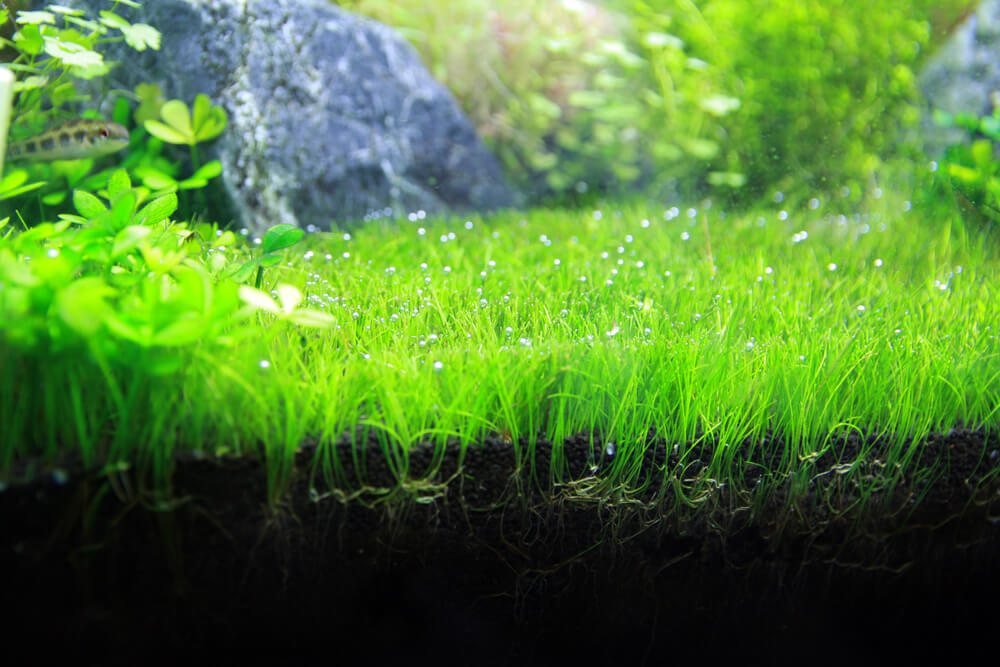
Dwarf hairgrass gives the finest, most lawn-like look on this list, and the sources disagree about it. Tropica rates its Mini form moderate in difficulty, wants moderate to strong light and recommends CO2 injection. The Good Algae (2020) lists it as a low-to-moderate light carpet needing no CO2. Glass Box Diaries found Eleocharis parvula easy to keep alive but extremely slow, and not one to buy for fast results.
That split is worth reading as a warning:
- Expect it to live in low tech but not to carpet quickly
- Plan for sand or fine substrate, as care guides say gravel gives a sparse, lumpy carpet
- Names vary: Aquafy sells dwarf hairgrass at $12.95 (5×5 cm), while Micro Aquatic Shop sells Eleocharis Belem at $14.95 (5 cm pot) and a tissue culture at $18.00
Against micro sword below, hairgrass is finer and taller-looking but asks for more light.
Pros
- Finest lawn-like texture of the six
- Easy to keep alive in low tech per Glass Box Diaries
- Tropica notes steady runner growth into a dense carpet
Cons
- Extremely slow without CO2 in a hobbyist test
- Tropica recommends CO2 while another source says none is needed
- Starting stock costs about 50 cents per sq cm (5×5 cm for $12.95)
4. Staurogyne repens – Best easy cover for low light tanks
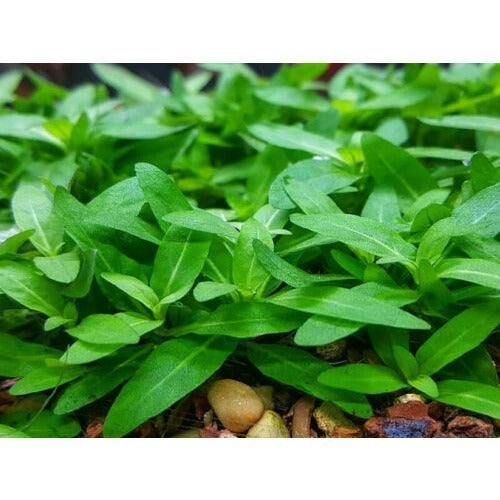
Staurogyne repens is a bushy low plant rather than a runner-carpet, and it is the easiest of the group. Tropica rates it easy, medium growth, minimal light and low CO2, and The Good Algae lists it first for beginners, needing only pruning. Aquafy sells 4 to 5 stems of at least 5 cm for $12.95, and Micro Aquatic Shop sells a tissue culture pot for $18.00.
Its trick is light. Tropica says low light makes it grow upward with fewer side branches, so trim the tallest shoots when planting and it will send creeping shoots from the base. Compared with Marsilea above, it gives a taller, leafier cover, not a flat lawn.
Pros
- Rated easy with minimal light and low CO2 by Tropica
- Needs pruning only, according to The Good Algae
- Trimming at planting encourages creeping shoots
Cons
- Grows upright, not flat, in low light
- Not a true lawn: it is a bushy foreground plant
- Growth reaches 3 to 10+ cm, so it needs regular trims
5. Micro Sword (Lilaeopsis brasiliensis) – Best slow, tidy lawn
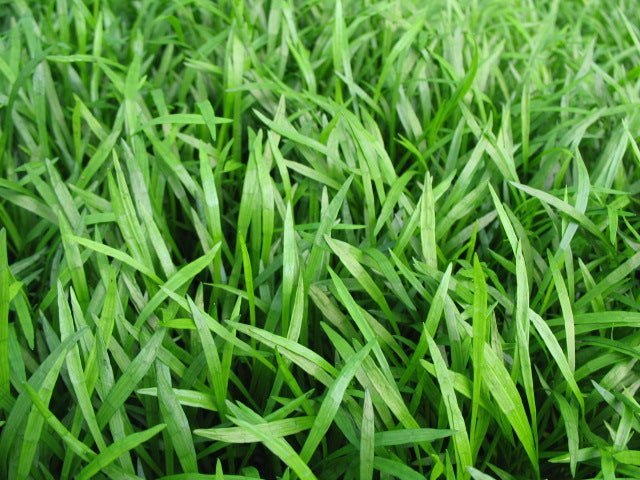
Tropica rates Lilaeopsis brasiliensis easy but slow, with medium light of about 0.5 W/L and CO2 of 6 to 14 mg/L. It can form a compact 4 to 7 cm lawn under intense light. Plant small clumps, about one eighth of a pot, a few centimetres apart with clear light overhead. Aquafy sells a 5×5 cm portion of 20 to 30 leaves for $11.95.
This is the pick with the thinnest evidence. I found no independent owner reports to check Tropica’s data against, so treat it as maker-rated only. Against dwarf hairgrass above, the shorter blades may suit a small tank better.
Pros
- Rated easy by Tropica
- Tolerates a range of conditions, including low-salinity brackish tanks
- Around 48 cents per sq cm of starting stock
Cons
- No independent owner evidence found
- Growth is slow compared with other carpets
- Needs clear overhead light, and neighbouring plants can shade it out
6. Dwarf Baby Tears (HC Cuba) – Best only if you run high light and CO2
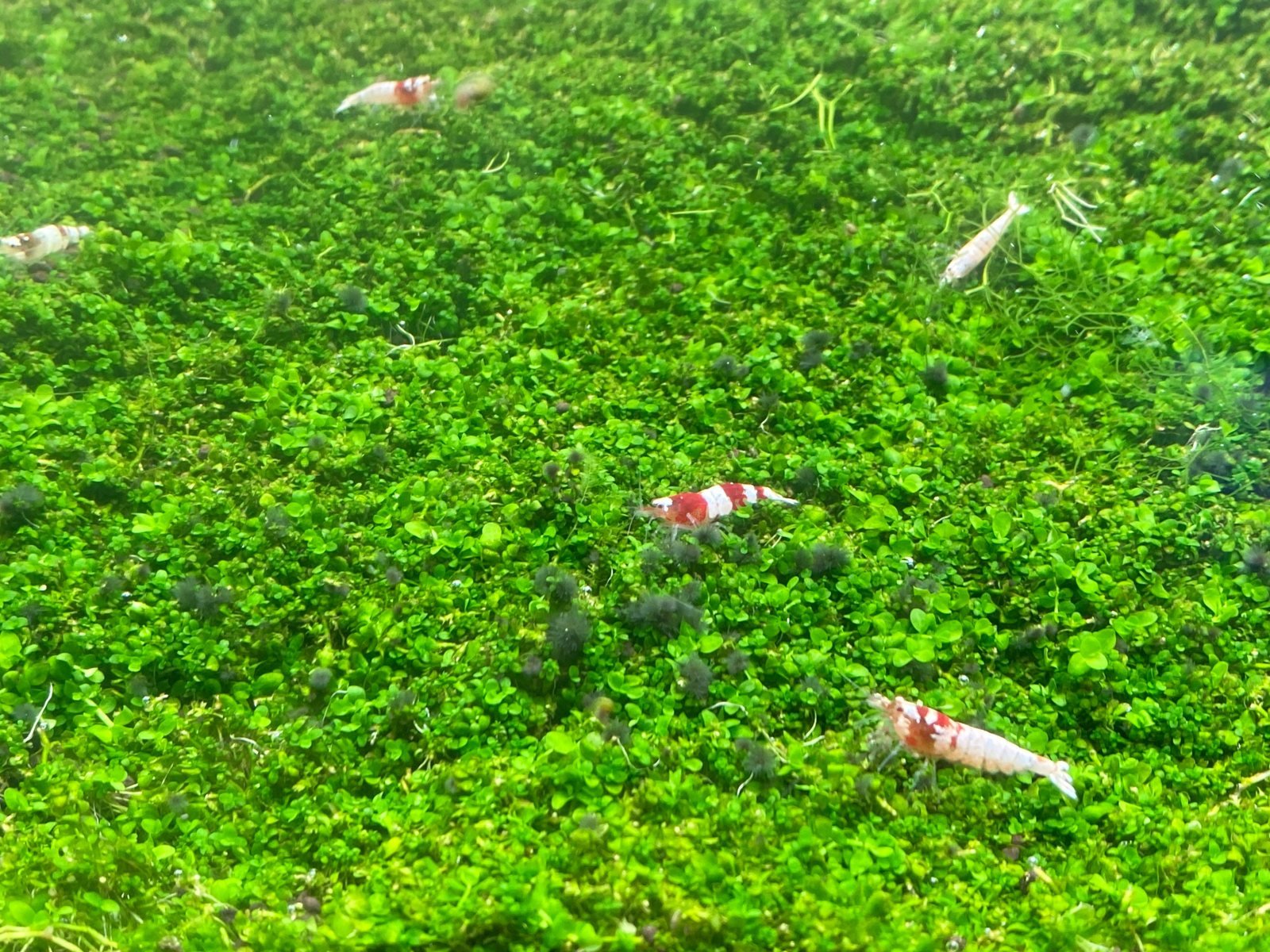
Dwarf baby tears is the carpet in every aquascape photo, and it is a hype-versus-reality case. Tropica rates it advanced and asks for high light, 15 to 25 mg/L of CO2, good water flow and fertiliser, and says regular trimming prevents rot in the lower layer. Aquariadise (2023) calls it moderately difficult and says a fine, nutrient-rich substrate and iron matter.
Aquafy sells a 5×5 cm portion for $12.95, about 52 cents per sq cm. If you cannot give it high light and CO2, buy Monte Carlo instead, as Tropica itself suggests.
Pros
- Finest leaves of any carpet, about millimetre-sized
- Available as both portion and tissue culture from Aquafy at $12.95
- Looks dense once established under the right conditions
Cons
- Tropica rates it advanced with high light and CO2 demand
- Roots must be planted deep or it floats free, per Aquariadise
- Costs more per sq cm than Monte Carlo
How to Choose
Start with your light. A carpet only forms if light reaches the substrate, and that is why Tropica ties Staurogyne to minimal light and Monte Carlo to good light. Then choose the substrate: a fine, nutrient-rich one helps hairgrass and dwarf baby tears, which is covered in the best planted aquarium substrates. Match the light with the best LED lights for planted aquariums.
Feeding matters too. Carpet plants are heavy root feeders, so root tabs help, as compared in the best aquarium plant fertilizers. Want a quicker answer? Use Marsilea in a low-tech tank, Monte Carlo with medium light and CO2, and leave dwarf baby tears for a high-tech setup.
Marsilea hirsuta is an Australian native, but that does not make it safe to release. Queensland lists Sagittaria platyphylla as a category 3 restricted plant that must not be sold, given away or released, and I left dwarf sagittaria off this list to keep things simple. None of these six is a Sagittaria. I have not checked every state list, so check yours before buying. Shop prices also differ: Marsilea was $9.95 at one shop and $16.00 at another on 29 September 2026.
Planted Tank Guides
Pair your carpet with easy species from the best aquarium plants for beginners, and browse the Live Plants and Aquascaping hubs for related coverage. Test your water before planting with the best aquarium water test kits.
- best foreground aquarium plants
- best low light aquarium plants
- what plants you can put in a fish tank
Frequently Asked Questions
Can you grow a carpet plant without CO2?
Yes, but pick carefully. Tropica rates Marsilea hirsuta and Staurogyne repens as low in light and CO2 demand, so both suit a tank without injected CO2. Monte Carlo, micro sword and dwarf hairgrass do better with it, and dwarf baby tears needs it. Without CO2 the demanding species spread slowly and grow patchy rather than dense.
How long does a carpet plant take to fill in?
There is no honest single number. Tropica quotes height after two months, not coverage. One hobbyist test rated moss carpets at two to three months to fill, but called Marsilea hirsuta very slow and dwarf hairgrass extremely slow without CO2. Plan on months, and plant small clumps a few centimetres apart to speed things up.
Why did my carpet plant melt or float up after planting?
Melting often follows the switch from emersed (out of water) to submerged growth, and Aquafy says its emersed Marsilea needs a few weeks underwater to transition. Floating happens when roots are not planted deep enough, a problem noted for dwarf baby tears. Trim off melted growth, replant firmly with tweezers and keep light and nutrients steady.
Are tissue culture cups better than potted carpet plants?
Tissue culture plants are grown in a sterile environment, so they arrive free of snails and algae, which matters in a shrimp tank. Potted or portioned plants usually cost less per portion and arrive in a bigger clump, but may carry hitchhikers. In Australian shops the price gap is often only a few dollars.
Are any aquarium carpet plants restricted in Australia?
Yes, in the wider aquarium plant trade. Queensland lists Sagittaria platyphylla as a category 3 restricted plant, so it must not be sold, given away or released. None of these six is a Sagittaria. Rules differ by state, so check your state’s list before buying, and never dump aquarium plants in a waterway.
For most Australian tanks, choose Marsilea hirsuta: it is native, rated easy with low light and low CO2 needs, and only slow, not fussy. If you can give medium light and CO2, Monte Carlo makes a denser and cheaper-to-start carpet, though a hobbyist test lost it to melting. Staurogyne repens is the easiest cover for low light, provided you accept a bushy look. Leave dwarf baby tears until you run high light and CO2, because Tropica rates it advanced.
